The AI Trojan Horse: How the Gift of Efficiency Hides Capitalism’s Hunger for Human Disposal
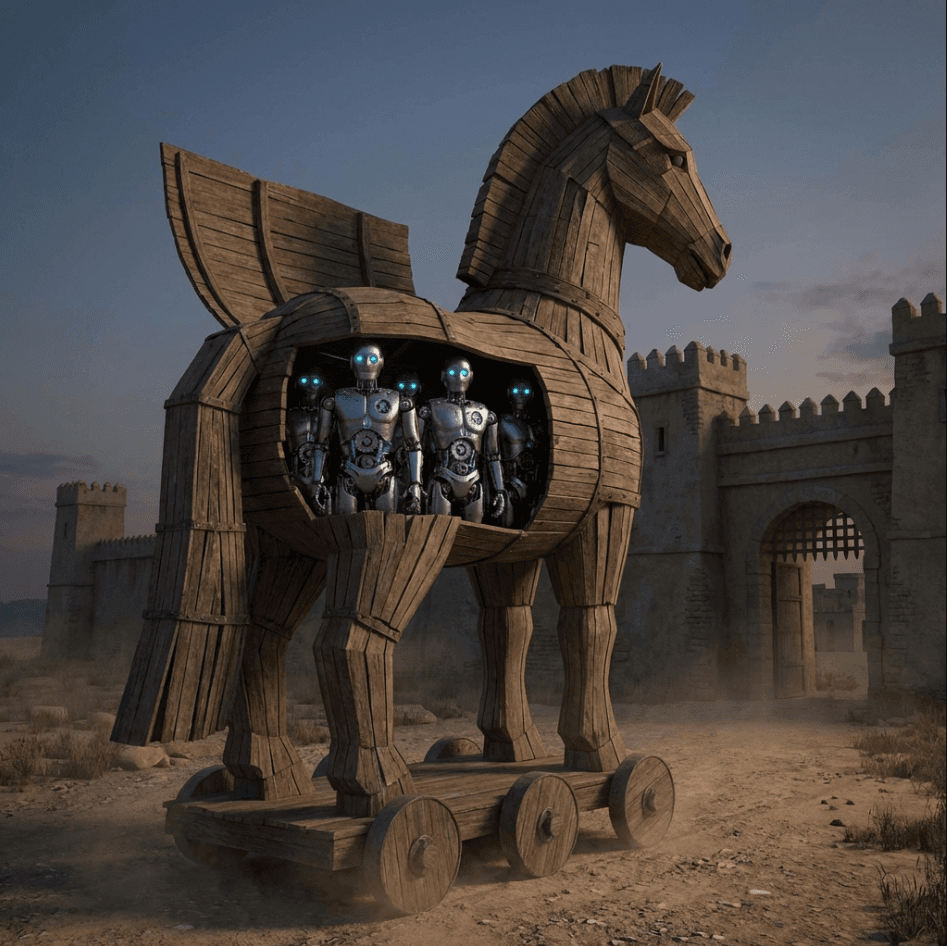
When the Greeks left a massive wooden horse outside the walls of Troy, the Trojans believed it was a gift—a tribute to their victory, a symbol of progress and peace. They dragged it inside, celebrated, and fell asleep.
The Ghost at the Feast – and the Rockstar who Always Delivers
When the Greeks left a massive wooden horse outside the walls of Troy, the Trojans believed it was a gift—a tribute to their victory, a symbol of progress and peace. They dragged it inside, celebrated, and fell asleep. That night, the hollow belly opened, and soldiers crept out to burn the city to the ground.
Today, artificial intelligence is our Trojan Horse. It arrives wrapped in the language of abundance: “Liberate your workforce. Increase productivity. Unlock human creativity.” The tech billionaires wheel it through the corporate gates with a smile. Boards of directors applaud. Shareholders cheer.
But inside that hollow belly is the same old hunger: the greedy nature of capitalism, sharper than ever. And when the celebration ends and the system goes to sleep, what creeps out is not a Greek soldier. It is a spreadsheet that says: “Replace the rockstar. Fire the data analyst. Let the algorithm fail silently. The bonus must be protected.”
I used to work for a telecoms company as a senior engineer, the definition of a corporate job. You know the type: huge customer base, thousands of failed calls per minute when a system breaks. And when that happened, everyone knew who the higher-ups would call. The Rockstar or stars.
Not the CEO. Not the VP of strategy. It was the one quiet engineer who understood the legacy switch, the database index that no one documented, the obscure routing table. That person would stay up for 36 hours, find the bug, and save the company millions in lost revenue – but more importantly, they saved the company’s reputation. Reputation is the only currency that matters in telecom as well as many other businesses. Lose that, and customers churn. The Rockstar was the human firewall between a working network and chaos.
Now imagine that Rockstar being replaced by an AI agent that can parse logs, correlate errors, and propose a fix in 12 seconds. Not augmented, replaced with a 6AM email. That is not a hypothetical. It is happening right now.
In the last six months – and I am being as conservative as I can – AI has already taken at least 100,000 jobs across North American companies. That is not a future projection. That is a current body count. And here is the part that should scare every person with a college degree: most of those 100,000, 1 year ago never spent five minutes asking themselves, “What if I am next?”
We are living in the gilded age of artificial intelligence. Stock markets are at record highs. Nvidia’s valuation defies gravity as well as logic and common sense. And Silicon Valley proclaims that we are entering a "limitless" era of productivity. But if you listen closely to the shop floor – the data analyst whose three-year-old report predicted massive growth, the network engineer who saved the company, you hear a different sound. It is the sound of a society barreling toward a cliff, distracted by the promise of shiny new toys.
To understand where the AI revolution is taking us, we must look backward – specifically to the 1920s. That decade was also a time of staggering technological innovation (electricity, automobiles, radio) and wild speculation. It ended, as we know, in a catastrophic crash and the Great Depression. But more importantly, to understand why we are likely to repeat the mistakes of the past, we must look at the engine driving it all: the greedy nature of capitalism.
As Karl Marx observed, capitalism contains the seeds of its own destruction. It relentlessly optimizes for efficiency and accumulation, often at the expense of the very workers who sustain it. Today, AI is the ultimate expression of that drive. The question is not whether AI will change the economy; it is whether the greed guiding its implementation will lead to a dystopian feudalism or whether capitalists will finally learn the lesson of 1929: that a healthy economy requires humanity, not just throughput.
The Marxian Lens: Machines as a Weapon and the Rockstar as a Cost
Karl Marx wasn’t against technology and as a software engineer, neither am i. He, like myself fully understands that machinery/technology could shorten the workday and liberate humanity from toil. What he and I completely oppose is the capitalist application of machinery and technology.
In Das Kapital, Marx argued that capitalists introduce machinery not to make life easier for workers, but to destroy the power of labor. By replacing skilled artisans with machines (or in our case, algorithms), the capitalist reduces the worker to a mere appendage of the machine. The goal is simple: increase what Marx called "surplus value" which is the difference between what a worker is paid and the value they produce.
The Rockstar engineer is the perfect target. Why? Because they are expensive. They have leverage. They know where the bodies are buried. In an era of ultra-capitalism, the human touch is being overlooked in a way that should terrify everyone. The corporate logic is brutal: if an AI can do 80% of what the Rockstar does for 0.1% of the cost, the Rockstar is a liability, not an asset. Never mind that the AI cannot handle the novel, never-before-seen outage. Never mind that the AI lacks intuition, context, and the memory of the last three outages. Never mind that humans are grease for the economy. The spreadsheet says: replace.
And it is not just engineers. The data analyst who spotted a trend three years ago that led to massive growth? Their insight was human – a pattern recognition that came from experience, frustration, and a hunch. AI can now generate a thousand reports in a minute. But it cannot feel the urgency of a failing network. It cannot care about reputation. And that lack of care is precisely why the greedy short-term playbook – the Trojan Horse – is so dangerous. I am speaking about these two industries as i am involved intimately but practically all industries are in the firing line, some just haven't felt it yet.
The 100,000 Jobs in Six Months: A Conservative Estimate
Let me be blunt. In the last six months, AI has displaced at least 100,000 workers across North America. I am being conservative. That number excludes call center agents, junior coders, copywriters, translators, and a thousand other roles that are being quietly eliminated.
For the C-suite, those 100,000 jobs represent something beautiful: the possibility of huge bonuses for a very few. For the workers, they represent even bigger losses – mortgages, tuition, car payments, dignity. And here is where the system’s fragility reveals itself.
Globalization is often used as a buzzword, but at a granular level, what it means is interconnectivity that goes miles deep. Less disposable income for 100,000 families does not just hurt those families. It affects hundreds of thousands of small businesses – the local coffee shop that sold to that call center worker, the daycare that watched their kids, the car mechanic who fixed their sedan. When money tilts too far to the 1% side, the entire economy begins to wobble. Giant empires can be brought to their knees not by a competitor, but by the simple weight of too many people having too little to spend.
This is not speculation. This is the lesson of 1929.
1929: The Last Time the Horse Was Opened
The 1920s were a marvel of productivity. Henry Ford’s assembly line revolutionized manufacturing. Output per worker soared. But there was a fatal flaw in the economic model of the time: the rewards of that productivity were not distributed to the workers who needed to buy the products.
In the 1920s, the top 1% of Americans owned more than 40% of the nation’s wealth. Wages stagnated while productivity skyrocketed. The capitalists believed they could keep the party going through credit and speculation. But when the market crashed in 1929, the underlying fragility was exposed. You cannot have a consumer economy if consumers have no money.
We are in a similar "Roaring Twenties" moment with AI. Productivity metrics are set to explode. Analysts predict AI will contribute trillions to global GDP. But who captures that value? Currently, the structure is hyper-centralized. Wealth is accruing to the owners of the compute (Nvidia, Microsoft, OpenAI) and the owners of the capital.
If we follow the greedy, short-term playbook – replace every human you can, as fast as you can, to boost this quarter’s margins – we will replicate the structural failure of 1929. Mass unemployment will lead to a collapse in aggregate demand. If 100,000 becomes 1 million, who will buy the products that AI-enabled corporations are producing? The system will choke on its own efficiency. The Trojan Horse will have emptied its soldiers, and the city will burn.
The "Start Your Own Business" Fantasy – and the Gladiator Ideology
I hear the counter-argument constantly. It came most recently from Aravind Srinivas, CEO of Perplexity: “People don’t like their jobs; there is a possibility to go start your own.”
Let me translate that from CEO-speak to reality. Aravind employs a number of people with one or two very specific objectives. That is the luxury of being the boss. Now imagine each of those 10, 12, or however many employees taking his advice. They would have to go and start 10 or 12 separate businesses – all likely competing in the same space, fighting for the same customers, the same venture dollars, the same fleeting attention. In that gladiator arena, only one, maybe two, will survive. The rest will fail, not because they lacked talent, but because the math of small business survival is brutal. The transition from ordinary worker to business owner is a massive leap that only a fraction of a percentage of people ever achieve.
Snapping your fingers and starting a business is pure fantasy. It ignores the reality of healthcare, rent, family obligations, and the simple fact that most people do not have a trust fund or a co-signer. To suggest otherwise is not wisdom; it is a rhetorical shrug aimed at absolving the system of its responsibility to the people it is displacing. It is the sound of someone standing safely outside the Trojan Horse, telling the people inside to just build their own horse.
The Peter Thiel Problem: Skull Island and the Disconnected Elite
Then there is Peter Thiel. The billionaire who co-founded PayPal, funded Facebook, and wrote Zero to One. He was recently asked about the continuity of humanity – about what happens to the rest of us when AI and automation have finished their work. He paused. Not a brief pause. A pause long enough to know how he really feels.
Peter Thiel has effectively isolated himself on Skull Island. He has built bunkers, bought property in New Zealand, and structured his wealth to survive 25 recessions back-to-back. His viewpoint is pointless to look at from a humane angle. He does not need the economy to work for everyone. He only needs it to work for him and his fellow lifeboat passengers.
This is the logical endpoint of greedy capitalism: the ultra-wealthy retreat into private enclaves, while the rest of us are told to compete in a gladiator arena or become entrepreneurs overnight. It is a vision of society that Marx predicted – a small class of owners and a vast, precarious class of disposable labor. And it is accelerating. The Trojan Horse was built for them, not for us.
How Does One Upskill in an Environment Where AI Is Reshaping Every Job?
This is the question no CEO has answered honestly. How does one upskill when the goalposts move every three months? When the AI that wrote your job description yesterday can do your job today? When every training course is already obsolete by the time you finish it?
The honest answer is that you cannot outrun a machine that is designed to learn faster than you. The only sustainable path is not to run faster – it is to change the rules of the race. That requires collective action, policy, and a fundamental shift in what we demand from capitalism. It requires recognizing the Trojan Horse for what it is and refusing to drag it inside.
What Capitalists Must Do: The Balance of Innovation and Humanity
If we are to avoid a Marxian revolution (where the dispossessed masses seize the means of production) or a 1929-style depression (where the economy collapses due to under-consumption), the capitalists leading the AI revolution must adopt a new framework. This is not about charity. It is about long-term self-preservation. Here is what they must do – in other words, how to stop building Trojan Horses.
1. Stop Treating Rockstars as Costs to Eliminate
The engineer who saved the telecom’s reputation was not an expense. They were an insurance policy against catastrophe. AI is brittle. It fails in novel ways. The human with context, judgment, and the ability to say “this feels wrong” is irreplaceable – if you value resilience over quarterly margins. Capitalists must restructure compensation to reward retention of human expertise, not its elimination.
2. Implement a Productivity Dividend
If AI makes a company 40% more productive, that surplus cannot go entirely to the C-suite and stock buybacks. To maintain aggregate demand, capitalists must share the gains. Profit-sharing, guaranteed bonuses tied to automation savings, or – on a macroeconomic scale – ending opposition to Universal Basic Income (UBI). If Sam Altman and Elon Musk warn that AI will eliminate jobs, yet capitalists lobby against a safety net, they are effectively advocating for a revolution.
3. Redefine Work Hours – Do Not Just Fire People
Marx dreamed of a future where automation reduced the workday to a few hours, allowing humans to pursue art, philosophy, and leisure. Capitalists today have the chance to deliver that. Instead of firing 20% of the workforce, why not reduce the workweek to 32 hours with the same pay? This maintains employment, increases human well-being, and keeps the consumer economy intact. It requires accepting lower velocity of extraction for higher stability of the system.
4. Acknowledge That Small Businesses Are the Shock Absorbers – Protect Them
Less disposable income kills small businesses. And when small businesses die, the giant empires lose their supply chains, their local distribution, and their political cover. Capitalists who want to survive must advocate for policies that keep money in the hands of the many – not just the few. That means fair taxation, anti-monopoly enforcement, and a genuine embrace of wage growth, not wage suppression.
Conclusion: The Choice is Theirs (But the Clock is Ticking)
Karl Marx believed that capitalism would inevitably collapse under the weight of its own contradictions. The Crash of 1929 nearly proved him right. It took the New Deal, massive public works, and a world war to reset the balance between capital and labor.
We are at a similar inflection point today. The "greedy nature of capitalism" is currently optimizing for a future where a handful of trillion-dollar corporations own the AI infrastructure, and the rest of society is left to fight over the scraps of a gig economy – or worse, to compete in a gladiator arena where only one in twelve businesses survives.
But capitalists have a choice – perhaps their last choice. They can continue to roll the Trojan Horse into the city, believing the gift is real. They can keep replacing humans until the consumer base evaporates and social unrest becomes unmanageable. Or they can act with enlightened self-interest.
To keep the balance of innovation and humanity, capitalists must realize that humanity is not a drag on efficiency. It is the market. No humans, no customers. No customers, no capitalism.
And for the Peter Thiels of the world, hiding on Skull Island? Your bunkers will not protect you when the supply chains collapse and the economy you abandoned finally comes for you. The Rockstar who saved the telecom might not be there to save you next time. Because you fired them. And they could not afford to start their own business.
The Trojan Horse is at the gate. The question is whether we will be smart enough this time to peek inside before we celebrate.
Next step
If reporting still lives in exports and spreadsheets, we can replace that
We build dashboards and pipelines that stay current without a weekly fire drill.

Author: Damion D Wilson
Admin - opsedsolutions.com