Website Redesign: Why Good UI/UX Is About More Than Making a website Look Better
A modern website should do more than look good. It should help users understand your business, navigate your services, build trust and take action. Here's how UI/UX design can turn a website redesign into a business improvement.
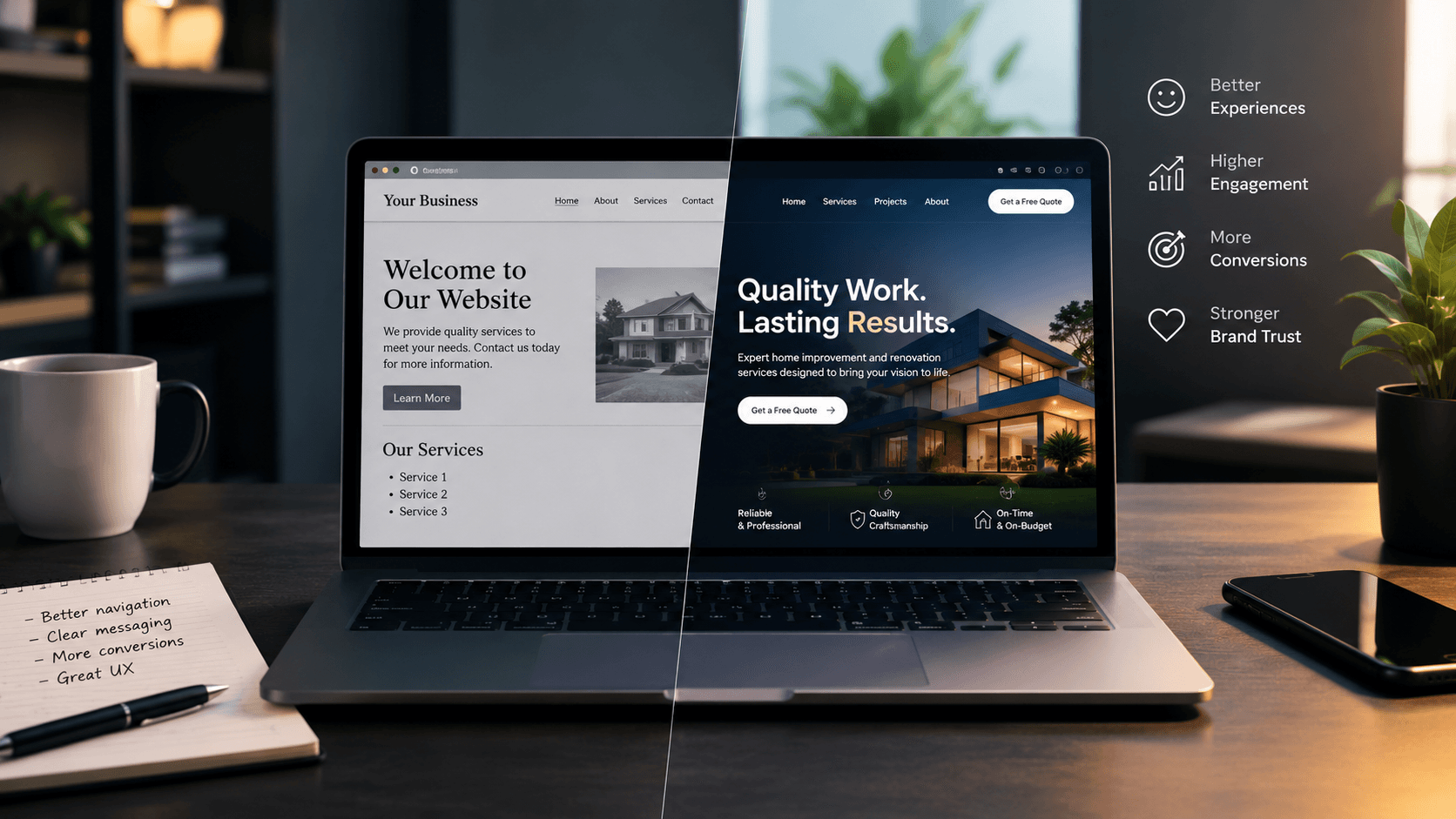
In a competitive landscape, any advantage is usually seized upon. Businesses spend heavily on better products, faster service, stronger marketing, and more efficient operations all in an effort to give customers a reason to choose them over the alternative. But one of the most visible parts of that competitive experience is often the website or application itself.
A website isn't simply a digital brochure. It is often the first interaction a potential customer has with a business, and that interaction can influence whether they trust the company, understand its offering, and ultimately take action.
This is where UI and UX become more than questions of aesthetics.
UI determines how the experience looks and communicates. UX determines how effectively someone can navigate that experience, find information, complete a task, and reach a decision.
Research from Nielsen Norman Group has documented the connection between UX improvements and business metrics such as conversion, task completion, and feature usage across numerous real-world projects. Their current UX research emphasizes measuring design changes against actual business and user outcomes rather than treating design as purely subjective.
There is also a credibility component. Research into website credibility has found that visual design, ease of use, expertise, and trustworthiness all influence how people evaluate a website. In other words, the experience a business creates online can influence how the business itself is perceived.
That creates an interesting competitive dynamic.
If two companies offer similar products, similar pricing, and similar service, the experience surrounding the purchase can become part of the differentiation.
A confusing navigation structure creates friction, a weak mobile experience creates friction, a slow or unclear checkout creates friction, a vague call-to-action creates friction. How much money does friction cost ?
Individually, these may seem like small design decisions. Collectively, they shape whether someone continues, converts, returns or chooses another option out of frustration.
Good UI makes a business look credible. Good UX makes it easier to do business with that company. The combination can turn the website from a digital brochure into a competitive asset.
What Does UI/UX Mean in Website Design?
UI and UX are closely related, but they aren't the same thing.
UI: User Interface Design
UI focuses on the interface users interact with such as:
- Layout + Typography
- Colours + Buttons
- Forms + Navigation
UX: User Experience Design
UX looks at the experience as a whole, It asks questions such as:
- Can visitors find what they need?
- Is the navigation intuitive?
- Does the content answer their questions?
- Are important actions easy to find?
- Is the mobile experience usable?
- Does the website create confidence?
- Are there unnecessary steps or sources of friction?
A website can have beautiful UI and still have poor UX.
That's why a redesign should consider both.
Why Website Redesign Should Start With the User ?
One of the first questions I ask when approaching a redesign is:
What is the user actually trying to accomplish?
The website should make that journey as clear as possible. This means the design process should begin with user intent, not decoration.
Consider a basic customer journey:
Landing → Understanding → Exploring → Trust → Action
If the website makes users repeatedly stop and ask:
"Where do I go now?"
there is probably a UX problem. The Homepage Has a Responsibility, it should establish context and communicate this particular business effectively.
I have decided to do some work and employ some of these principles and I've been putting this philosophy into practice through a series of website redesign projects.
Trita Parsi Website Redesign
In this project, I examined the existing experience and explored how the interface could be restructured with stronger hierarchy, clearer presentation and a more intentional visual system.
The goal wasn't simply to make the website different.
It was to explore how the design could better communicate the person's work and guide visitors through the information.
Watch the redesign:
YouTube — Website Redesign | Trita Parsi | UI/UX
Tinnel's Patties Website Redesign
For Tinnel's Patties, the redesign approached the website from a business and customer-experience perspective. A food business website needs to do more than display attractive food photography.
It needs to make it easy for customers to understand the product, explore their options and ultimately decide what to do next.
Watch the redesign:
YouTube — UI/UX Website Redesign | Tinnel's Patties
The Difference Between a Website That Looks Good and a Website That Works
A website can receive compliments like "That looks amazing." But the more important questions are:
Can users find what they need?
Do they understand the offering?
Can they navigate the site easily?
Does the website build trust?
Can they complete the action the business wants them to take?
Does the website work well on mobile devices?
Can the business measure what is happening?
Those are the questions that turn website design into a business conversation.
What Happens Behind the Website Matters Too
At Opsed Solutions, I approach web development from more than just the visual side.
A website may connect to:
- Databases
- APIs
- Payment processors
- Authentication systems
- CRM platforms
- Analytics
- Content management systems
- Automation workflows
- AI services
- Business intelligence platforms
The interface is often only the visible portion of a much larger technology system. That's why UI/UX is particularly interesting to me.
I can start with what the customer sees and then think about what needs to happen behind the scenes.
UI/UX + Full-Stack Development
This combination changes how I approach projects.
For example, imagine a company says:
"We need a new website."
Instead of stopping at the design, I can ask:
What does the customer need to accomplish?
↓
What does the business need to capture?
↓
Where should that information go?
↓
What systems need to connect?
↓
What should be automated?
↓
What data should be measured?
↓
How will we know whether the new website is actually performing better?
Now the project isn't simply a website redesign. It's a digital system improvement.
Good UX Creates a Better Foundation for Growth A website should be able to evolve with the business.
That means thinking about:
- Performance
- Accessibility
- Mobile responsiveness
- SEO
- Content structure
- Analytics
- Scalability
- Integrations
- Maintainability
A beautiful interface that becomes difficult to maintain six months later isn't necessarily a successful solution.
The goal should be to create something that works today while providing a foundation for what the business needs tomorrow.
My Approach to Website Redesign
When I approach a redesign, I like to think through five areas:
1. Understand
What does the business do?
Who does it serve?
What are the business objectives?
2. Analyze
What is working?
What isn't?
Where are users likely to encounter friction?
3. Structure
How should the information be organized?
What should the navigation look like?
What does the user journey need to be?
4. Design
How should the interface communicate the brand and guide the user?
5. Build & Measure
How will the design be implemented?
What technology supports it?
How will performance and user behaviour be measured?
That final step is important.
A redesign shouldn't necessarily be the end of the process.
It should give you something you can continue improving.
UI/UX Is One Part of the Bigger Picture
This is ultimately how I think about my work at Opsed Solutions.
I'm interested in UI/UX design.
I'm interested in full-stack development.
I'm interested in data analytics.
I'm interested in data engineering, integrations, automation and AI.
But the common thread is solving problems with technology.
The website is sometimes the problem.
Sometimes the website is only the visible symptom of a larger problem.
And sometimes the biggest opportunity is connecting the website to the systems and data behind it.
That's where things get interesting.
Final Thoughts
A website redesign shouldn't begin with:
"How can we make this look better?"
A better starting question is:
"How can we make this work better for the people who use it and the business that depends on it?"
That's the difference between redesigning a website and improving a digital experience.
My recent redesign projects are an opportunity to demonstrate that process in practice.
If you're interested in improving your website whether the problem is UI/UX, performance, functionality, integrations, analytics or the technology underneath it that's the kind of work I do at Opsed Solutions.
Next step
If reporting still lives in exports and spreadsheets, we can replace that
We build dashboards and pipelines that stay current without a weekly fire drill.

Author: Damion D Wilson
Admin - opsedsolutions.com